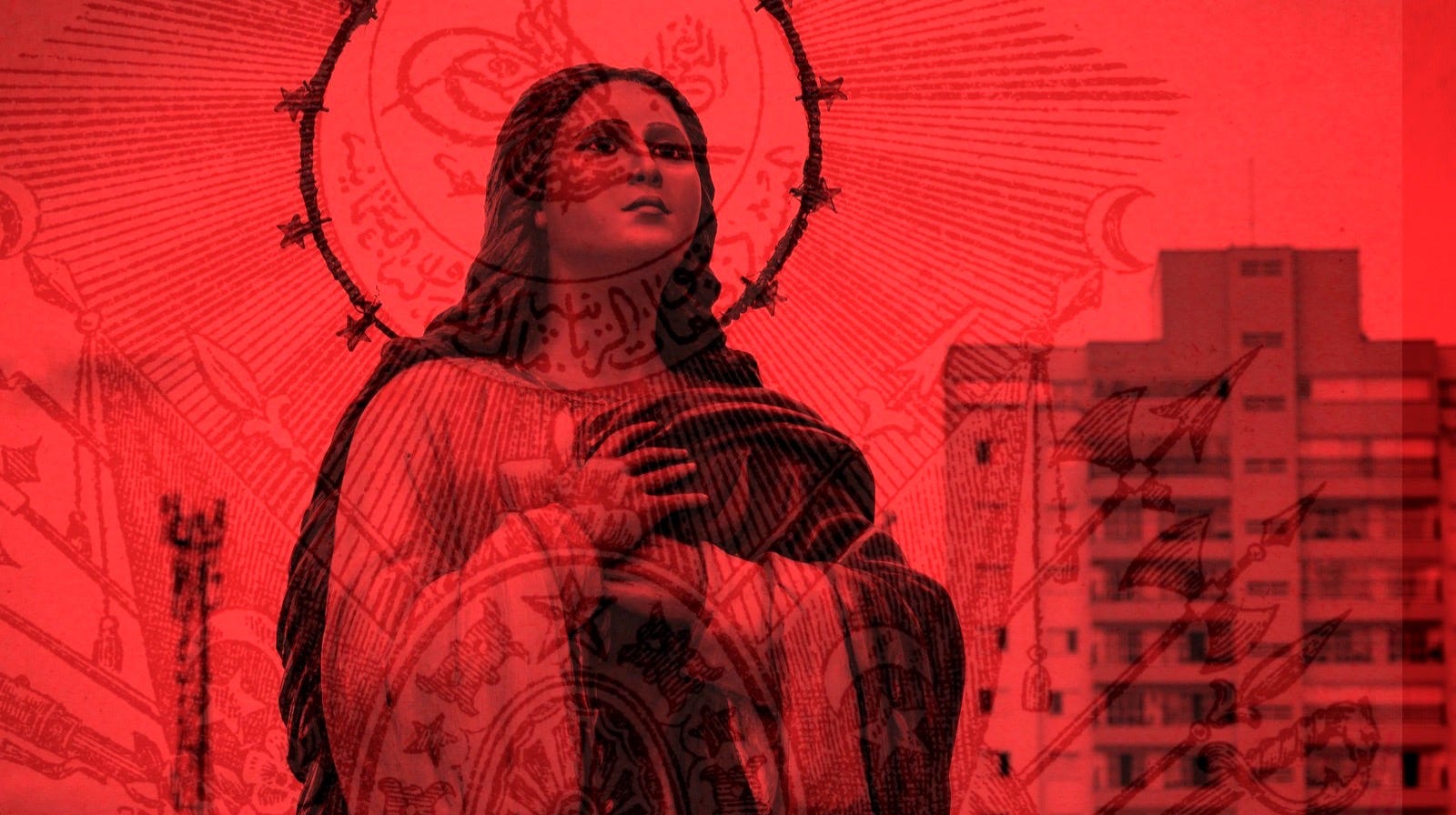
Holiness, or Hypervigilance
An esoteric autopsy of bad kenosis, false light, and the long con of choosing your struggle.

I called myself an empath for a long time.
The word seemed to explain something that hadn’t been explainable.
Something primordial.
Something inherited.
Like when a room would land in my body before anyone in it had spoken, the way I could tell which version of someone was about to walk through the door.
And, the way certain people emptied me in a way I couldn’t articulate and certain rooms refilled me in a way I couldn’t either.
I thought I was tuned to a frequency other people couldn’t pick up. I thought that was a kind of holiness. It took me longer than I’m proud of to ask the harder question.
What if I wasn’t tuned to anything?
What if I was just scanning?
“I said to my soul, be still, and wait without hope, for hope would be hope for the wrong thing.”
—T.S. Eliot, Four Quartets
If Carl Jung and Gabor Maté had a patient zero, she would look a lot like me.
She would have read the room before she learned to read. She would have mistaken her attunement for wisdom and her wounds for credentials. She would have been correct—just about the wrong things, in the wrong direction, toward the wrong people, for the longest time.
Jung would say I was seized by an archetype—that something ancient and enormous got its hooks in me through a person-shaped door and I called it recognition because I didn’t have better language yet.
Maté would say the child who learned that love was conditional learns to feel her way toward whoever needs her most and calls that love too.
Both of them would be right.
Neither of them tells you what the Gnostics knew: that the seizure was older than your childhood, and the door you held open had been propped by something with a much longer agenda.
And if, like me, you are the particular flavor of sensitive that gets forged in a particular kind of early, you don’t just open the door—you hold it open and apologize for the draft.
The trauma literature has a name for what I was doing, and the trauma literature is not wrong.
A small body that learns early to track the weather doesn’t stop tracking it just because the weather changes.
The scanning becomes the personality, the personality becomes the self, and by the time anyone hands you a word for it the wiring is so old it feels like a soul.
That’s the floor.
The floor is not the interesting part; the interesting part is the cosmology—and the cosmology is older than the diagnostic frame by about two thousand years.
Archon is a Greek word. It means “ruler.”
My friend Chad calls them the crime I fight for fun in my spare time.
He’s not wrong.
In ancient Athens, it was an official public governing title. In Gnostic cosmology it became something darker: the name for the celestial beings who built and maintain the material world, and who have a vested interest in keeping you in it.
Not servants of truth—administrators of the counterfeit.
These beings were powerfully omnipotent, deceitful, and almost impossible to see unless you know what you’re looking for.
You don’t—unless they want you to.
Jesus, depending on which gospel you’re reading, knew their names. So did the Ars Goetia—the grimoire cataloguing 72 demons, each one a ruler of something.
Gnostics and the ceremonial magicians weren’t working from the same text.
They kept arriving at the same list.
“Ignorance of the Father brought about terror and fear. And terror became dense like a fog, so that no one was able to see.”
—Valentinus, The Gospel of Truth
There’s a Gnostic gospel called Pistis Sophia; it got buried in the Egyptian desert with the rest of the Nag Hammadi library and stayed buried until 1945.
The text says her name is Sophia. Says it means wisdom.
In the story, she is sitting in her proper place in the higher realms, longing to reach it. And the lower powers—these malevolent rulers of the material world—see her longing.
Then, they do something elegant and terrible.
They emanate a false light below her—a counterfeit, a glamour. And Sophia, being Sophia, mistakes the false light for the real one and descends toward it.
That’s the whole catastrophe.
She wasn’t punished. She wasn’t proud. She was tricked. She reached for what she thought was the source and the source had been spoofed.
Once she’s in the lower realms, she can’t find her way back.
The archons strip her of her light-power. She doesn’t know where she is.
The texts say she weeps and her tears became the waters of the world. Every soul, the Gnostics said, carries a fragment of her. Not a metaphor—a fragment—a piece of the goddess who reached for what she thought was the light and got catfished by something with a lion’s face and an agenda.
The divine spark in you isn’t your potential. It’s her, but scattered.
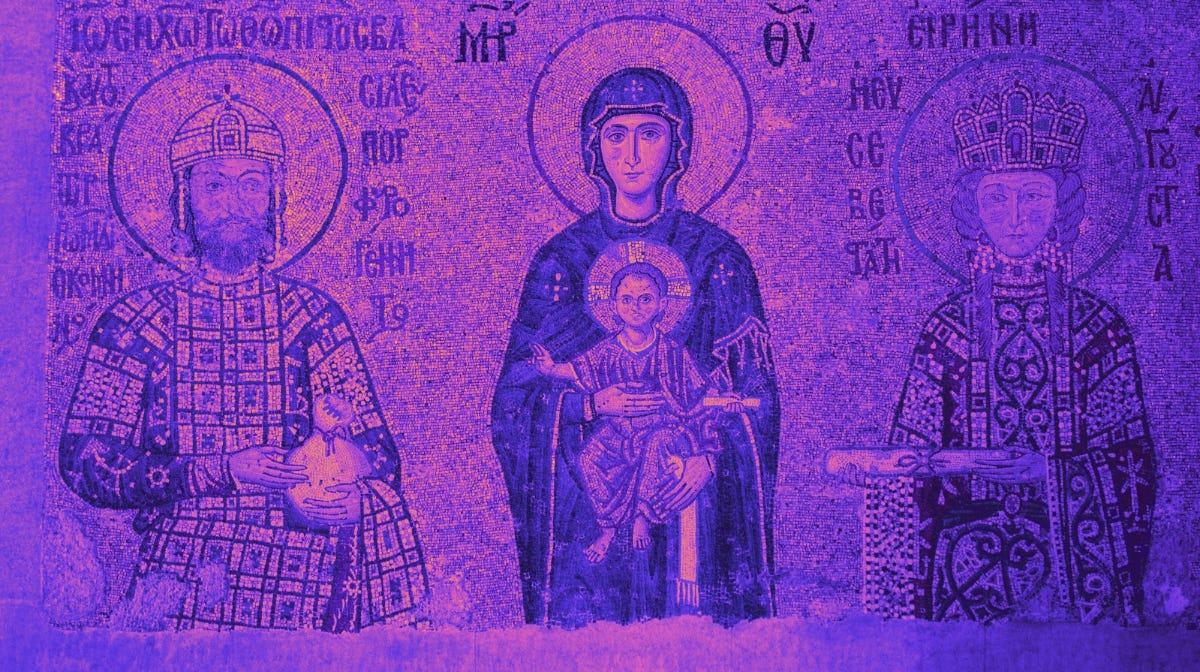
“She did not know where she was, and she could not return again to her original place. And she began to weep and cry out to the Light of Lights which she had seen from the beginning.”
—Pistis Sophia, Book I
There’s an old word in mystic theology, kenosis, which means “self-emptying.”
The Christians used it for what Christ allegedly did pouring himself into a body. The Thelemites, Crowley’s people—occult magicians who weren’t afraid of a chalice—used it for the way the adept pours themselves out completely into the Cup of Babalon, leaves nothing back, becomes the offering.
Different theology, same gesture.
What stopped me when I first read about it was what one of those Thelemic writers said almost in passing: People-pleasing is an example of bad kenosis—the reflexive kind; the unconscious kind that calls servitude, love.
The empath, as we’ve been performing her, has been doing kenosis the whole time; that’s what the emotional absorbing is, what the “room-reading” is.
We’ve been pouring ourselves out—out into the marriage, into the family, into the friend, into the stranger.
We’ve been emptying. We just haven’t been choosing the cup.
That was Sophia’s trick—and it's mine.
Some of us learned from it.
Some never will.
Most, live under the label happily ever after.
Because—the longing feels real. The longing feels fucking holy. And detaching from it feels violent because the self that formed around it thinks it’s God. It’s not.
The ego conditioned across a lifetime of early, the one that learned to scan and reach and empty and call it love. It has no category for not being the source; it will defend itself like a deity.
Then, it will call your healing “a betrayal.”
“In each of us there is another whom we do not know.”
—C.G. Jung
The Gnostic story doesn’t end at the fall. It ends with her coming back. Not by becoming less sensitive or sealing herself off, but by discernment—revealing, slowly, what is the True Light and what is an archon running a con.
By some act of marionette metaphysics that I have no business questioning, something in me I’ll call wisdom, recognized something else in me I’ll call home, and moved toward it.
I’m not finished with the discerning.
I don’t think anyone is.
Nobody escapes the struggle. The game doesn’t offer that option. What it offers is the choice of which struggle; one that keeps you scanning, or one that attunes.
The paradox is this: that which drains what you pour out into the world, and the way back home to yourself, are one and the same.
The gift and the wound are never two things.
Neither are Sophia and the Empath.